

OVERVIEW AND PROCEDURE
Urodynamics is a study that assesses how well the bladder and urethra are storing and releasing urine. If you have a problem with urine leakage or blocked urine flow, one of the tools your doctor may use to evaluate the cause of your symptoms is urodynamic (testing, studies, investigations).
Urodynamic tests help your doctor to see how well your bladder and sphincter muscles work and can range from simple observation to precise measurements using sophisticated instruments.
Most tests measure your bladder’s ability to hold and release micturition. Your healthcare provider will determine a treatment plan for your symptoms based on the results of these tests.
Urodynamics includes various tests that are used to measure the changes in pressure and filling in the bladder and urethra during the filling and emptying process. A thin measuring catheter is inserted into the bladder via the urethra to measure pressure and volume. During the examination, the patient may be asked to perform various actions, such as urinating or coughing, to check the functioning of the bladder and urethra.

SIMPLE URODAMICS
- Before and after the tests
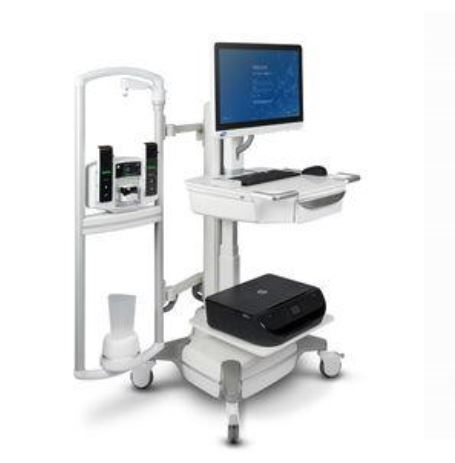 You don’t need to do much to prepare for these tests, but you will need to give a urine sample<
first to make sure you don’t have an infection. Also, check with your doctor if you need to stop taking any medications before the test. Urodynamics includes various tests that are used to measure the changes in pressure and filling in the bladder and urethra. These tests take about 30 minutes. If you have a urinary infection, you’ll need to take antibiotics before you can have the test. If you are pregnant, please call the clinic right away. Your urodynamics evaluation may need to be postponed. Drink enough water so that you arrive at your appointment with a full bladder. (If you have a Foley catheter, there is no need to drink more water than normal.)
While the insertion of catheters can feel uncomfortable or produce a minor burning sensation
the process is generally not painful.You may experience mild irritation or slight blood in your urine for a short period after the test. An antibiotic may be prescribed for 1 or 2 days to prevent infection, but not always. People with signs of infection—including pain, chills, or fever—should call their healthcare provider immediately.
- Uroflowmetry
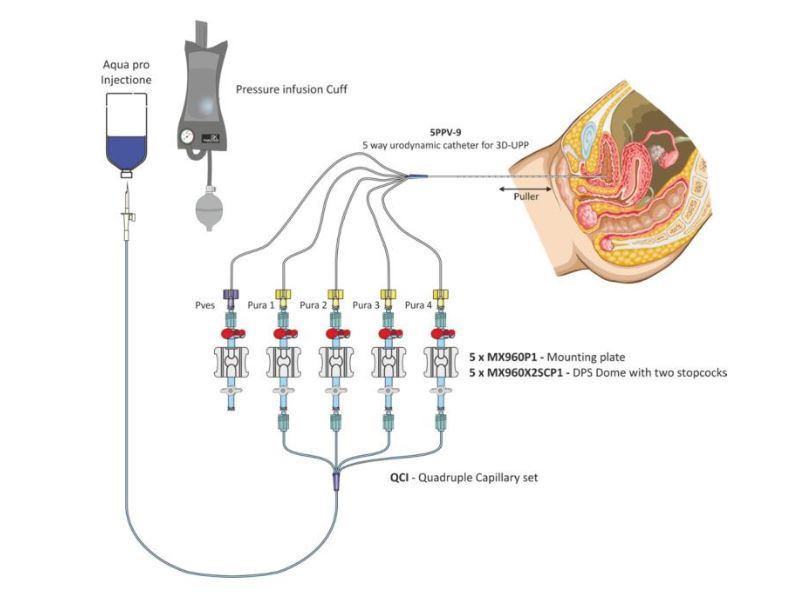 An uroflowmeter automatically measures the amount of urine and the flow rate. You may be asked to urinate privately into a toilet that contains a collection device and scale. This equipment creates a graph that shows changes in flow rate from second to second so your doctor can see the peak flow rate and how many seconds it took to get there. Results of this test will be abnormal if the bladder muscle is weak or urine flow is obstructed. Typically in woen, urine flow runs from 15 ml to 21 ml per second. Mean flow rate in men ranged betwwen 21 ml/s to 12 ml/s.
- Post void Residual Measurement
After you have finished urinating, you may still have some urine, usually only an ounce or two, remaining in your bladder. To measure this post void residual, your doctor can measure the post void residual with a catheter or an ultrasound equipment. Less than 50 mL PVR is considered normal. Up to 100 mL PVR may be acceptable. A post-void residual of 150 mL or more is often a sign that the bladder is not emptying completely.
- Cystometric Test or Cystomanometry
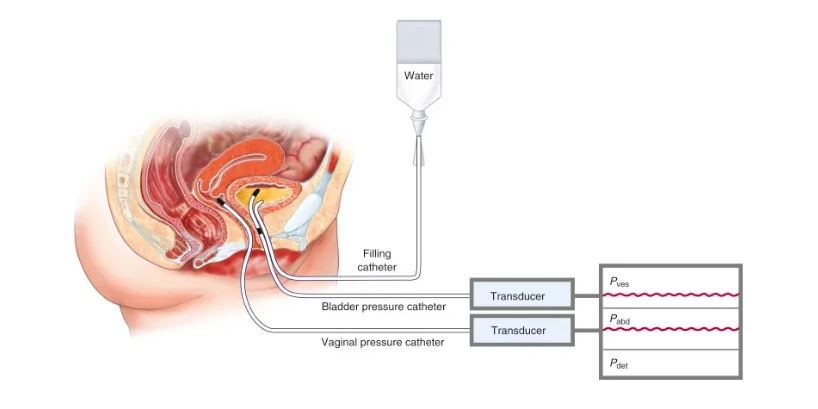
A cystometrogram (CMG) measures how much your bladder can hold, how much pressure builds up inside your bladder as it stores urine, and how full it is when you feel the urge to urinate. If you need a cystometry test, you may be asked to lie down, sit, or stand. During the test, a thin tube (catheter) will be gently placed into your urethra with a numbing gel to make it more comfortable. Another catheter may be placed into the rectum or the vagina to record pressure into your belly (abdominal pressuer). During the time of filling, you will be asked how your bladder feels and when you feel the need to urinate. You may be asked to cough or strain during this procedure to see if the bladder pressure changes. With this test involuntary bladder contractions can also be identified which is correponding of an overactive bladder. Normal functional bladder capacity in adults ranges from approximately 300 to 500 mL but most people feel the need to urinate when it’s holding around 200 mL.
- Urethral Profilomery Test
The UPP measures the intraluminal pressure along the length of the urethra and is part of the tests that form urodynamic evaluation.. A specialized catheter (often equipped with pressure transducers) is gently inserted into the bladder. As the catheter is steadily withdrawn at a controlled rate, the equipment plots a topographic curve of pressure measurements from the bladder neck down to the external opening. UPP help the to evaluate your sphincter muscles wich could be weak (intrinsic sphincter insufficiency) or urethral hypertony. The normal value of urethral closure pressure can be derived by the formula 110-age or 92 – age
OTHER URODAMIC TESTS
- Leak Point Pressure Measurement
 While your bladder is being filled for the CMG, it may suddenly contract and squeeze some water out without warning. The manometer will record the pressure at the point when the leakage occurred. This reading may provide information about the kind of bladder problem you have. You may also be asked to apply abdominal pressure to the bladder by coughing, shifting position, or trying to exhale while holding your nose and mouth. These actions help the to evaluate your uretral sphincter muscle wich could be weak (intrinsic sphincter insufficiency) or urethral hypertony.
- Pressure Flow Study
After the CMG, you will be asked to empty your bladder. The catheter can measure the bladder pressures required to urinate and the flow rate a given pressure generates. This pressure flow study helps to identify bladder outlet obstruction in men who may experience with prostate enlargement. Bladder outlet obstruction is less common in women but can occur with a fallen bladder or rarely after a surgical procedure for urinary incontinence. Most catheters can be used for both CMG and pressure flow studies. Some people may find it difficult to empty their bladders with a catheter or with another person in the room. Don’t be embarrassed if this happens. While you might feel your healthcare provider inserting the catheter into your urethra, the test doesn’t hurt.
- Electomyography
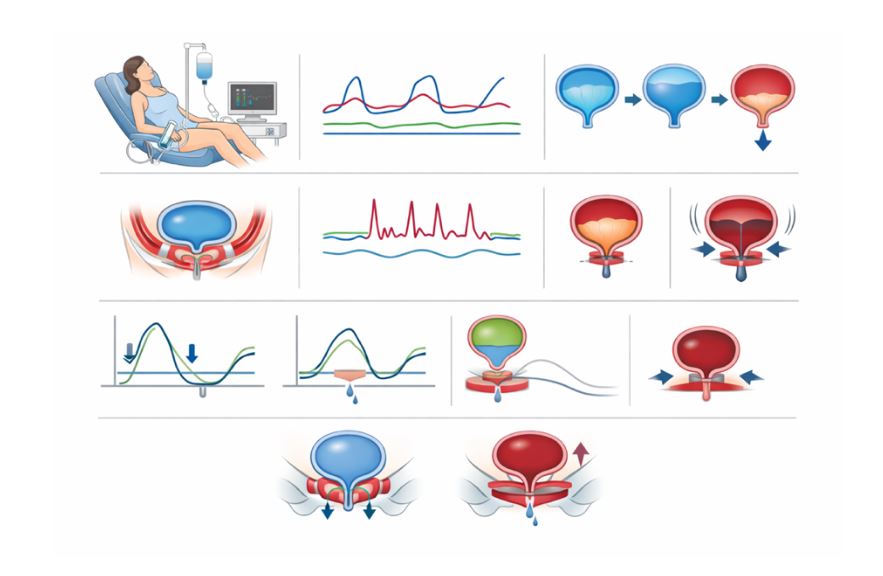 Electromyography uses special sensors to measure the electrical activity of the muscles and nerves in and around your bladder and sphincters. During a urodynamic EMG test, small electrode patches are placed near the urethra and rectum. The physician then asks the patient to contract and release the muscle several times to test the area. The electrode sends signals to contract the muscle and records the response, using a numerical value to show functionality. The patterns of the nerve impulses show whether the messages sent to your bladder and pelvic floor muscles are coordinating correctly.

WHAT ARE THE RESASONS FOR URODYNAMIC TESTING
Why the Test is Done
Doctors recommend urodynamic studies to diagnose and manage conditions like urinary incontinence, overactive bladder, and difficulty emptying the bladder. It is particularly useful :
- If initial conservative treatments (like a bladder diary, pelvic exercises or medication, ) do not
- provide clear answers ;
- Unsuccessful previous surgery
- Frequent urination or an urgent need to urinate ;
- To define the type of incontinence, particularly when the history is unclear e.g. in cases of
- very severe incontinence with continuous leakage
- Difficulty starting urination or a weak urine stream ;
- A feeling of incomplete emptying after urinating ;
- Unexplained urinary retention ;
- Neurological disorders e.g. spinal cord injuries, strokes, head injuries, multiple sclerosis,
- Parkinson’s disease
Pourquoi Faire un Bilan Urodynamique?
A note from our Center
You should be given the results from our tests the same day. Your healthcare provider with talk with you about the test results once they have them and to discuss the next steps and treatment.
Urodynamic testing helps diagnose conditions that affect your bladder, urinary sphincter and urethra. They’re safe and relatively simple tests that can give your refering doctor insight into how your bladder stores and releases. Once you have got the curves and the report, we may recommand to see your doctor in order to provide you with best therapy.

References
Urodynamics Your Pelvic Floor
https://www.yourpelvicfloor.org › media › Urod…
British Association of Urological Surgeons. Urodynamics.pdf
https://www.baus.org.uk › Patients › Leaflets ›
Mark Yao, Adrian Simoes: Urodynamic Testing and Interpretation. Last Update: August 14, 2023.
Chew LE, Hannick JH, Woo LL, et al.: The Future of Urodynamics: Innovations, Challenges, and Possibilities. Neurourol Urodyn. 2025 May 14;45(2):293–298.
Mc Crossan K, Vickers H : A basic understanding of urodynamics. Obstetrics, Gynaecology & Reproductive Medicine Volume 35, Issue 3, March 2025, Pages 63-72